A strategic, technological, and legal compendium of FOOH and CGI campaigns
Spis treści:
1. What is FOOH really?
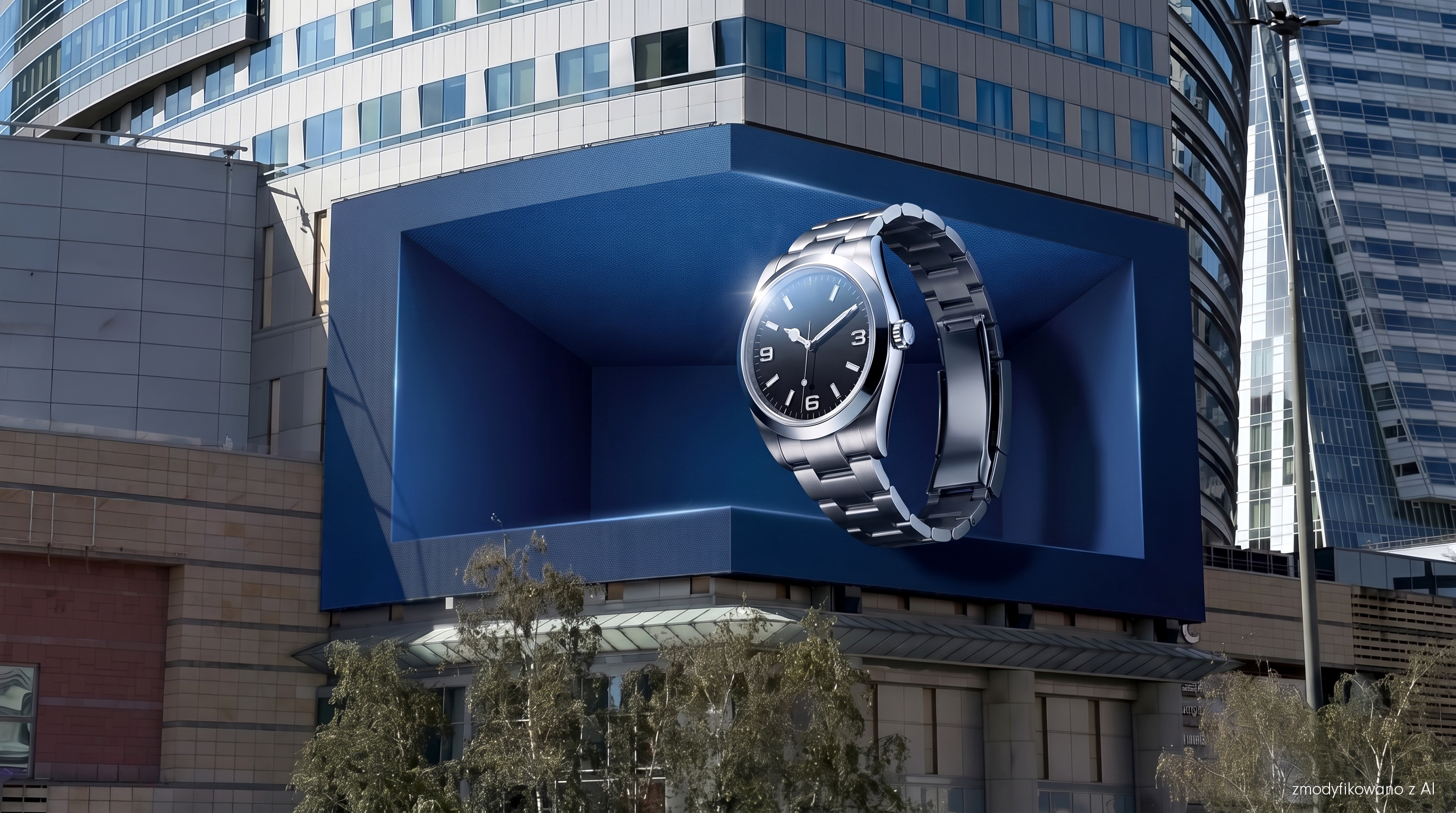
FOOH (Fake Out of Home) is a concept that has redefined the boundaries between reality and digital creation in recent years, becoming one of the most effective tools for building organic reach. Technically, it is a hybrid advertising format that involves embedding photorealistic 3D objects (CGI - Computer Generated Imagery) into authentic video footage of a physical space. The key element of this definition is the word "embedding." We are not dealing with simple video editing here, but with advanced spatial composition, where digital objects must not only share the perspective of the background but also react to the prevailing lighting conditions, shadows, and physical obstacles.
The components of FOOH success are based on three pillars: the authenticity of the base, the precision of tracking, and the excellence of 3D and post-production. The base, or the video footage, often intentionally mimics the aesthetic of User Generated Content (UGC). The use of shaky cameras, sudden focus shifts, or compositional imperfections makes the viewer's brain automatically classify the image as "real," which lowers their defensive barrier against advertising messages. A layer of CGI is then applied to this foundation, which must undergo a process of matching to the camera and depth of field. This consistency makes events that are physically impossible—such as giant objects levitating over a city square—believable to the viewer.
FOOH is an intervention into a physical context familiar to the viewer. Using global or local landmarks serves as a strategic anchor for the message. Recognizing characteristic architecture, such as the Palace of Culture, causes the brain to automatically integrate digital objects with the real environment.
An interesting fact from elomate: In the FOOH production process, the most critical moment is not the 3D model itself, but the camera tracking process. This involves mathematically recreating the camera movement from the real footage within a virtual environment. If this process is performed incorrectly, the viewer's brain will immediately detect unnatural "floating" of the object, which will destroy the effect and reduce the advertisement to the level of a cheap video trick.
FOOH advertising requires creators to have an aesthetic sense and a deep understanding of the physics of light and optics. Technologies once reserved for high-budget Hollywood productions have reached the hands of brands, allowing them to create advertisements that would be technically impossible or logistically unattainable in the physical world.
2. Evolution of the format: From realism to surrealism
The beginnings of the FOOH format were inextricably linked to the pursuit of absolute photorealism and the imitation of the physical limitations of traditional outdoor advertising. The first viral productions tried to convince the viewer that what they saw on their phone screen was a physically existing installation, the assembly of which would be extremely difficult and expensive, but theoretically possible. The "fake OOH" aesthetic dominated—giant handbags moving through the streets of Paris or monumental banners unfurled on Dubai skyscrapers. At that time, realism was the only way to trigger a sense of surprise in the viewer. The more the footage resembled an amateur video shot by a passerby on a smartphone, the stronger the campaign's organic reach.
Very quickly, however, the industry and the viewers themselves began to realize that limiting themselves only to what is feasible in the physical world drastically narrows a brand's creative potential. There was a shift toward surrealism and full-scale CGI campaigns that stopped pretending to be physical installations and began to create a new, digital layer of reality. It was understood that the viewer does not need to believe that a given object actually exists to feel excitement while watching it. This change allowed brands to create completely impossible scenarios—from objects changing their state of matter to monumental mascots interacting with city architecture.
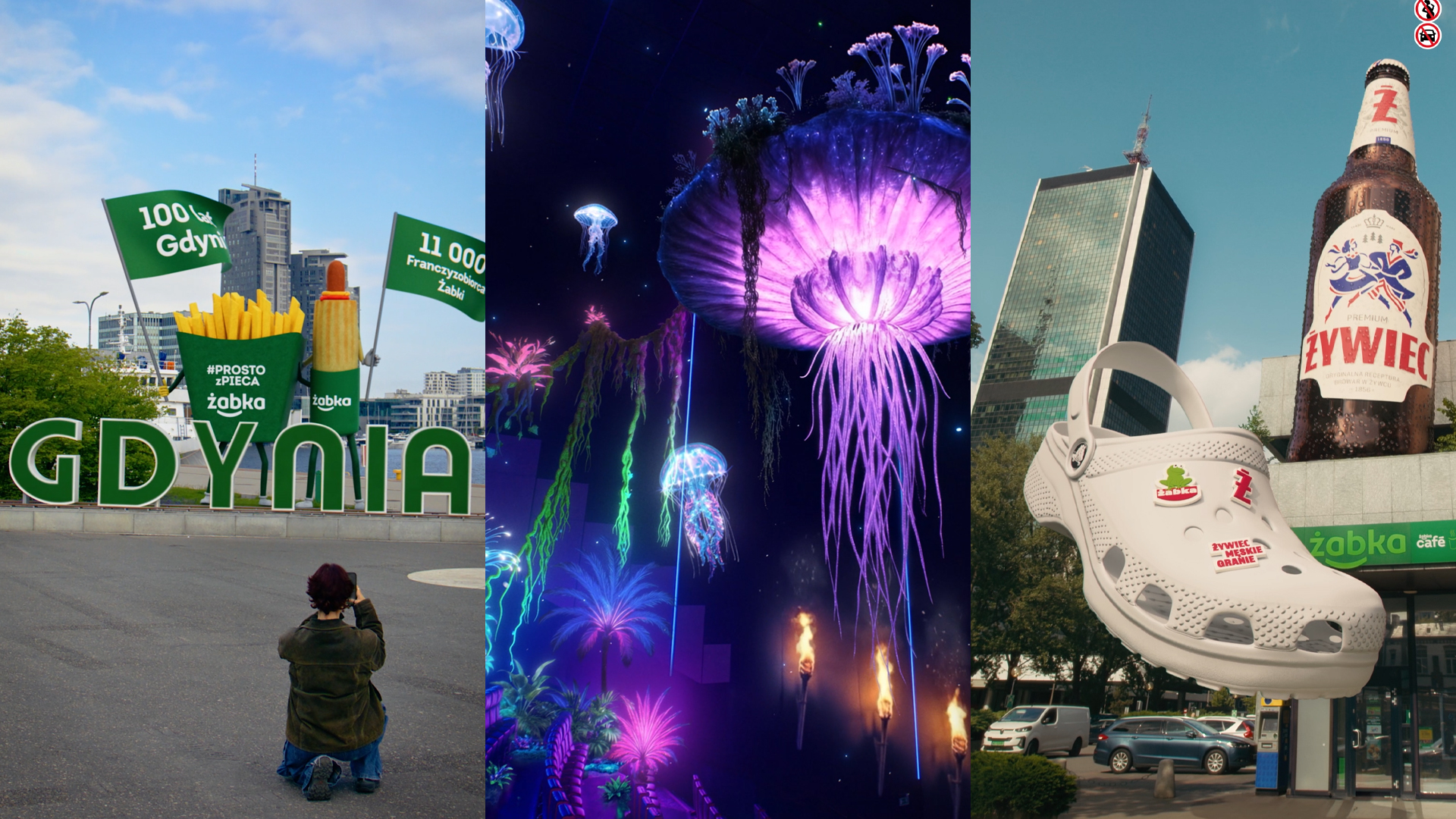
This evolution has shown that surrealism in FOOH can paradoxically strengthen branding. When we stop trying to trick the viewer into thinking they are looking at a real billboard, we gain the space to showcase a brand's DNA in an uninhibited way. An example of this shift is the elomate project for the Żabka chain, where giant, animated mascots ran onto the facade of the Palace of Culture and Science. From the standpoint of physics and logic, it was an absolutely impossible situation. However, by grounding these characters in the real, universally recognized context of Warsaw and maintaining realistic shadows and reflections, the footage gained massive popularity. Viewers didn't judge it through the lens of "truth," but rather through the lens of the brand's creative courage.
An elomate fun fact: Although an object may be impossible (e.g., a levitating building), its interaction with the environment must be logical. If such an object casts a correct shadow on a neighboring tenement house and reflects in its windows, the viewer's brain accepts the surrealism as part of reality. It is these details that allow for total freedom in the conceptual layer.
Today, the line between "real" and "created" no longer runs along the idea itself, but along the quality of execution. Brands that understand this shift stop asking, "Will people believe this?" and start asking, "How much can we delight them with this?" The transition from simply mimicking reality to creatively overwriting it is the moment FOOH became a communication tool ready to take on the role of the main protagonist in a 360° campaign.
3. FOOH vs. traditional OOH
Traditional out-of-home (OOH) advertising has struggled with the same limitations for decades: space rental costs, printing logistics, and physical construction barriers. Even the most innovative installations are limited to one specific geographic location, meaning their actual reach is determined by foot traffic at that specific point in the city. In this context, FOOH (Fake Out of Home) turns the tables, offering brands the ability to create a monumental installation that requires no building permits and has the potential for global distribution in real-time. Instead of paying for a physical presence in Times Square, a brand invests in the digital creation of that presence, gaining a significantly higher return on investment due to the viral nature of the format.
CGI technology, which until recently was reserved exclusively for the largest Hollywood film studios, is now accessible to the advertising sector, offering a level of photorealism indistinguishable from reality. The production cost of an advanced FOOH video, which will be watched by millions of people worldwide, is often a fraction of the amount that would have to be spent on the production, assembly, and rental of space for a physical installation of a similar scale. For FOOH, there are no material limitations or laws of gravity. The only cost is the work of experts, which allows brands to build structures online that would be a logistical nightmare or financial suicide to erect in the real world.
A traditional billboard rarely becomes a topic of conversation over coffee or gets shared on social media. FOOH, however, thanks to the element of surprise and the blurring of the lines of realism, provokes viewers to interact. Every share, comment, or repost of the video is free reach that drastically lowers the unit cost per impression. As a result, a FOOH campaign becomes a self-propelling content distribution mechanism, where the initial production budget is recouped many times over in the form of advertising value.
FOOH is not a competitor to traditional OOH, but rather its evolution toward digital media. It allows brands to "occupy" the most prestigious locations in the world without the need for a physical presence on-site. For media agencies, it is a tool for optimizing 360° campaign budgets, where a single high-quality piece of CGI content can become the main reach engine for the entire communication strategy, outclassing traditional, static formats in terms of effectiveness.
4. FOOH as the anchor of a 360° campaign
Integrating CGI formats with traditional media is a turning point for media agencies looking to break through the consumer attention crisis. Treating FOOH as an isolated asset limits its strategic potential. This format achieves true effectiveness when it becomes the central anchor of a multi-channel campaign, around which the rest of the narrative is designed. Such synergy allows for the creation of a cohesive user experience.
Designing campaigns with FOOH as the protagonist requires a shift in mindset. Instead of treating animation as an add-on, media planning experts use it to trigger an initial surprise that generates organic public discussion and PR coverage. The buzz created around the brand in this way provides the perfect foundation for introducing standard formats that serve a closing and sales-driven function.
Incorporating FOOH into the mainstream of a 360° campaign requires strict discipline from creative teams. The animation cannot be detached from the main slogan or business objectives. It must be their visual essence. Only when a dynamic 3D object directly reflects product benefits or company positioning does this format cease to be a one-off display of technical capabilities, driving sales and recognition on a market-wide scale.
5. Legal minefields: Building "image" and copyright
Executing FOOH campaigns in public spaces requires rigorous legal analysis. The rapid development of this technology has outpaced legislative frameworks in many countries, making it complicated to navigate the areas of copyright and the protection of architectural objects. A common mistake in the advertising industry is the belief that since a building is located in a public space and is visible to everyone, it can be modified at will in digital commercial material. The key issue here is the relationship between the statutory freedom of panorama and the protection of the copyrights of architectural project creators. While the law allows for the free distribution of works permanently exhibited on publicly accessible roads or squares, the commercial, digital modification of these works—for example, by adding a giant character interfering with the facade structure—can be considered an infringement of the integrity of the architectural work.
The very concept of "image" in the Polish legal system generally refers to natural persons, not building structures. This leads to the conclusion that a building as a physical form does not possess an autonomous right to its image that could be violated by the mere act of filming it. On the other hand, it is worth looking at this through the prism of protecting private property or the corporate rights of those managing prestigious facilities. Many institutions or private consortia register a building's distinctive architectural shape as a spatial trademark. Using such an object in a strictly commercial campaign without prior authorization exposes a brand to allegations of unfair competition or infringement of trademark rights, which drastically increases the legal risk of the entire venture.
Everything depends on the specific advertising concept, the nature of the modifications, and the legal status of the chosen location. At elomate®, from the very beginning of the FOOH format's emergence, we have treated legal aspects as an integral and critical element of the pre-production phase. Every creative concept and selected location goes through a verification process by a team of specialized lawyers who analyze the risks. Such preventive analysis allows for the modification of design assumptions at an early stage or the acquisition of required consents, ensuring the brand is fully protected against potential claims for damages from creators or property managers.
The legal security of FOOH campaigns does not lie in avoiding distinctive or iconic buildings, but in developing proven procedures and having substantive support from the first days of working on a project. Large brands and media agencies cannot afford to operate in a high-risk zone, which is why the standardization of legal processes, alongside technological ones, is a necessary condition for successfully delivering the product. A well-honed process and collaboration with experts guarantee that the finished campaign will bring the expected viral reach without negative reputational or legal consequences.
6. The task force: Who creates FOOH ads?
The technological, legal, and strategic scale of professional FOOH productions requires the involvement of a specialized, interdisciplinary team. At the very beginning of this chain are the strategists and creatives whose main task is to align the concept with the campaign goals and brand identity. They are the ones who decide whether a dynamic object should entertain or showcase technological innovation, ensuring that every second of the animation has its justification in the broader DNA of the company.
Once the concept is approved, the video team steps in to capture the perfect base footage. Fieldwork requires precise planning, accounting for the time of day, sun angle, and lens optics, all of which are critical for later realism. Simultaneously, as demonstrated in the previous chapter, legal experts conduct essential analyses, verifying the location's status regarding freedom of panorama and intellectual property rights to ensure no claims arise before the project moves to the next stages.
3D and motion artists build digital twins of objects and integrate them into the real-world background. They are responsible for modeling, texture mapping, physics simulation, and perfectly matching the lighting to the conditions on the video set. Their work is complemented by editors and compositing specialists who merge the real and virtual layers, masking background elements and applying camera grain. The process is finalized by sound designers, whose sound effects make the digital objects feel even more real.
Having such diverse expertise within a single project structure is the only way to efficiently deliver a seamless and secure product. Large media agencies and global brands seek partners with the necessary technological infrastructure and a battle-tested production process. Integrating creative, technical, and legal roles into one team eliminates the risk of errors at the intersection of different work stages. When this process runs smoothly, the phase from site survey to final render stays within predictable timeframes, and the finished material achieves millions of views without technical or organizational barriers.
7. Audience psychology: Do people feel deceived?
The effectiveness of an FOOH campaign depends primarily on how audiences process the digital illusion. In the early stages of this format, there was a widespread industry fear that revealing the hoax would make consumers feel manipulated, leading to negative brand sentiment. Market practice has debunked this, showing that the key to a positive reaction is not hiding the use of CGI. Audiences do not reject the illusion as long as it provides unique aesthetic or entertainment value, serving as a manifesto of a brand's creative courage rather than a cynical attempt to mislead.
Negative reactions arise mainly when an idea is clichéd, derivative, and adds nothing new to the space. Consumers instantly decode the creators' intentions and ignore content that mindlessly copies competitors, regardless of the technology's sophistication. The psychological acceptance of digital intervention is based on a mechanism similar to that of watching a movie. Viewers willingly suspend their disbelief if the world offered to them is intriguing enough. If the project's intent is to delight the viewer with an impossible, surreal vision, the audience responds with admiration for the brand's innovation and humor, eagerly sharing the content across their channels, which eliminates reputational risk.
A key factor in shaping positive sentiment is avoiding narratives based on literal misinformation. Understanding the psychology of the digital crowd allows for the cultivation of the right emotions around a campaign. Instead of fearing accusations of "fakeness," brand managers should treat CGI as a unique opportunity to expand the brand's world with elements that would be physically impossible to build. When this process is based on strategic purpose and respect for the aesthetics of the space, the boundary between reality and creation ceases to be a barrier and becomes a space where authentic, long-term consumer engagement is born.
8. A trend or a permanent part of the landscape?
The rapid popularization of spatial CGI formats has sparked a debate in the advertising industry about the longevity of this phenomenon. Some mainstream analysts were quick to argue that FOOH (Fake Out of Home) is merely a short-lived fad that will disappear once audiences get used to digital illusions and lose their initial sense of surprise. Such predictions stem from a superficial understanding of media evolution and are refuted by hard market data. These formats have been growing steadily for several years, and global engagement and organic reach statistics show no downward trend. Treating FOOH as a passing fad is a mistake. In our view, we are witnessing the birth of an entirely new, autonomous advertising format that has become a permanent fixture in the digital media landscape.
The accusation that the format will soon "wear off" can be applied to any other visual communication medium, from classic video spots to static graphics. If a creative idea is clichéd, derivative, and adds no new value, the material will be ignored by users, regardless of whether it was created using 3D technology or as a traditional photograph. The decline in the effectiveness of some CGI campaigns is therefore not due to fatigue with the technology itself, but rather to the creative laziness of creators who mindlessly copy existing patterns. FOOH, as a format based on innovation, requires constant redefinition of creative boundaries. As long as brands can surprise audiences with fresh humor, surreal physics, and unique storytelling, this format will maintain its massive viral effectiveness.
This leads us to a technological evolution that will bridge FOOH with augmented reality (AR) in the coming years. Today’s CGI videos viewed on smartphone screens are merely a transitional phase. The true potential of this format will be unlocked once digital installations are integrated with smart AR glasses, allowing virtual structures to be viewed in real time directly within the urban fabric. Brands that are already investing in refining the production and legal processes associated with FOOH are building the technological capital that will allow them to seamlessly enter the era of interactive, three-dimensional spatial marketing.
The stability of the format is confirmed by the fact that major media agencies have begun treating CGI as a standard budget component in 360° campaigns rather than a risky experiment. FOOH's ability to generate massive organic reach at a relatively low cost makes it an excellent answer to the rising costs of traditional paid media. As long as digital screens remain the primary battleground for consumer attention, technology that allows for the creative overwriting of reality will be a vital tool for building a competitive advantage for modern enterprises.
9. Courage as a prerequisite
The culmination of our analysis of the coming era of spatial marketing must be a return to the fundamental human factor that ultimately determines commercial and viral success. Although CGI technology has reached a level of sophistication that allows for the flawless embedding of illusions into the urban fabric, and media agencies can precisely calculate advertising value, the primary factor differentiating a brand in the market remains creative courage. Technological infrastructure and processing power have been democratized, meaning the barrier to entry for high-budget visual effects no longer exists. In this new market landscape, the real bottleneck is no longer the production budget, but the courage to break away from patterns and offer audiences something that disrupts the routine of their daily lives.
This leads us to the philosophy upon which elomate builds its approach to motion design. We are not a generalist agency—we specialize in motion design that frees brands from visual mediocrity and builds real market advantage. We believe that every second of animation and every intervention in public space must have an absolute justification in the brand strategy, but this purposefulness cannot mean being conservative. Brands that try to treat FOOH as a safe, traditional billboard are wasting the potential of this medium. Success requires an acceptance of controlled surrealism, stepping beyond physical boundaries, and full trust in production processes that are, by definition, meant to surprise the consumer.
In today’s attention-based economy, the authenticity of an idea becomes a company’s most valuable asset. Betting on original, unique solutions is the only way to create lasting brand equity, as any attempt at imitation or thoughtless copying of others' viral content will remain merely a derivative copy ignored by the audience. On the other hand, it is worth viewing creative courage as an investment with the highest rate of return. When a company decides to execute a highly unique project, such as the mascots running onto the Palace of Culture, it not only generates organic reach but also manifests its position as a leader that is not afraid to dictate new rules of visual communication.
In summary, the FOOH format and advanced CGI campaigns are ultimately redefining the concept of outdoor and digital advertising. Motion has become the new foundation of branding. Refined video form and technical excellence are our standard and the starting point for every project, while a fresh, uncompromising idea determines whether the illusion turns into brand capital.