
Przemysław Białasz
I believe in the power of animation to help brands stand out and showcase their true values. As a brand and motion designer and co-founder of nalepsze and elomate studios, I have spent years ensuring that every project is unique, refined in every detail, and delivered on time. I hold a degree in computer science with a specialization in graphics and multimedia, having gained experience in advertising agencies and created projects for brands such as WWF, COMARCH, DPD, and Philips. I combine branding expertise with the skills of a 3D animator and generalist to propose solutions that increase brand recognition and support business goals. Inspired by technology, artificial intelligence, and business, I spend my free time making movies, practicing photography, and playing the ukulele. I help companies, agencies, and studios translate their unique DNA into engaging animations and consistent branding that captures attention and builds lasting relationships with audiences.
pozostałe artykuły

What is 3D anamorphic advertising?
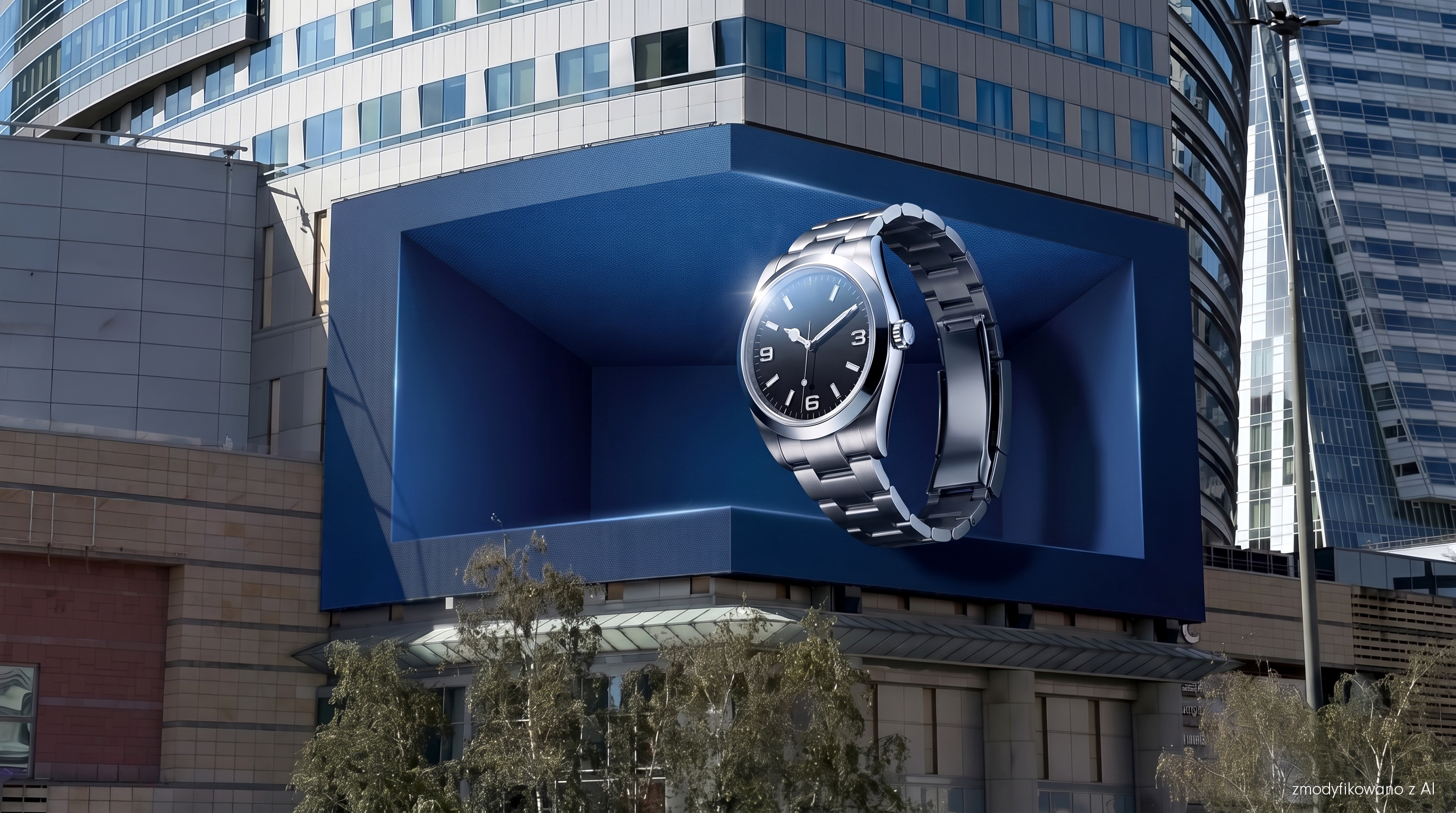
Anamorphic advertising uses a specially designed perspective to create an illusion of depth on a flat screen. The viewer does not need glasses or any additional equipment, which is why the format is often referred to as naked-eye 3D. The screen can create the impression of a window leading into a much larger space. An object can appear to be deep inside a building or, conversely, cross the boundary of the screen and reach out toward the viewer. This is not a hologram or a real three-dimensional image. The entire effect is based on an optical illusion. The perspective lines, object scale, and virtual camera settings are prepared so that the image looks spatial from a specific viewing point. That is why the term "3D DOOH advertising" is significant here. It is not just about creating an animation in 3D software; it is about designing it for a specific digital display in a real-world space.
Why isn't standard 3D animation enough?
An animation might look great on a monitor, a website, or a classic advertising screen while completely failing to utilize the potential of an anamorphic display. The reason is simple: such a screen must be taken into account during the design phase. Its proportions, the number of surfaces, corners, the image-joining point, and the spot from which viewers most often look at the ad all matter. The virtual camera must correspond to this perspective. This sometimes leads to a situation where the image viewed directly in the software may look heavily distorted. Only after it is displayed on the correct screen and viewed from the right spot does everything come together into a single space. That is why a finished spot cannot simply be "converted to anamorphic." The display should be part of the creative thinking process from the very beginning.
First the screen. Then the idea.
Producing an anamorphic ad does not start with modeling a product or creating flashy movement. First, you must understand the location where the material will be viewed. We analyze the screen's construction, its proportions, and the main viewing point. The surroundings are also important: the building, the street, the direction of pedestrian traffic, or the distance from the display. All of this can influence the concept itself. A screen corner does not have to be a problem we try to hide; it can become part of the set design. Multiple surfaces can create a single digital interior. A product can utilize the scale of the facade or interact with the architecture. The 3D effect should stem from the idea, not be tacked onto it. If the only concept is "let's make something come out of the screen," it is easy to end up with a demonstration of technology rather than a good advertisement.
The space should work for the product and the brand
The most interesting anamorphic projects are not those where the most things fly toward the viewer. It is much more important why we are using the space. A product can cross the screen boundary to emphasize its form more strongly. A digital interior can reveal its construction. A change in scale can turn a small object into the main protagonist of an entire facade. There are many possibilities, but the technology should support the message. This is especially important now, as these types of projects will become more frequent. The moment an object "comes out of the screen" will eventually stop being a sufficient differentiator. A viewer might remember a flashy animation while completely forgetting which brand was behind it. Technology attracts attention. The idea determines what the viewer remembers from that attention.
What does the production of an anamorphic ad look like?
After defining the display and the creative direction, the actual 3D scene is created. Depending on the project, we prepare models, materials, lighting, the product or character's environment, and the animation itself. One of the most important elements is the camera. Its position influences whether the created space will look natural, whether the product will maintain the correct scale, and whether the individual screen surfaces will create one cohesive image. Only in such an environment do we design the movement. Finally, the animation is rendered according to the parameters of the specific display and prepared in the formats required by its operator. Resolution, frame rate, codec, or spot length can vary depending on the screen, which is why production should always be based on the current specification. This is one of the things that strongly distinguishes this format from creating a universal film that is later adapted to several aspect ratios.
3D DOOH advertising is also emerging in Poland
A great example of this format's development is the Warsaw STAGE at Złote Tarasy in Warsaw. It is a three-sided LED screen with a surface area exceeding 800 m², designed to allow for creative content that spans multiple connected surfaces. Its structure perfectly illustrates why anamorphic DOOH requires a different approach to content creation. The footage can flow between walls, utilize the building's corner, and create the illusion of a single, vast space existing behind the screen. However, Warsaw STAGE is just one example. Every screen has different geometry, proportions, and viewing conditions, which is why the same creative should not be mindlessly transferred between different displays.
3D DOOH advertising - see how we design creatives for specific screens →
Why do 3D ads have the potential to go beyond the screen itself?
An interesting feature of this format is that a campaign can operate in two spaces simultaneously. The first is, of course, the broadcast location. The large screen and unique spatial effect are designed to capture the attention of people in the immediate vicinity.
But then, the second space comes into play: the internet. People record these unique displays with their phones, post them on social media, and share them further. Campaign footage can also appear in the brand's own communications, industry media, or PR activities. You cannot engineer a viral hit or guarantee a specific number of organic shares. However, you can increase the chances that the creative will be interesting enough for viewers to want to record it. That is why it is crucial that the key moment is clearly visible in a phone recording and that the brand remains recognizable even without knowing the full context of the campaign. A well-designed DOOH campaign can thus start working far beyond the location where the screen is installed.
Anamorphic 3D advertising vs. FOOH - what is the difference?
These formats are often confused because both can feature spectacular events that seemingly take place in real space. However, the difference is fundamental. In 3D DOOH, the advertisement is actually broadcast on a physical screen. The creative must therefore be prepared for a specific display, its geometry, and the viewing angle. A passerby can actually see it on-site. FOOH, or Fake Out of Home, is primarily video content. It can show a massive product on a building, an impossible installation, or an event that never actually took place. In 3D DOOH, we design an illusion for the screen and the viewer standing in front of it. In FOOH, we design an illusion primarily for the camera and the viewer watching the finished video.
See how we create FOOH animations →
When does anamorphic advertising make sense?
Not every campaign needs a naked-eye 3D effect. If you need to convey a lot of text, a complex offer, or several pieces of information of equal importance, a classic DOOH animation might simply be a better solution. 3D DOOH is particularly interesting when the product itself allows for playing with form, material, scale, or space. It also fits well with product launches and brand campaigns where a strong first impression is key. It is also worth considering this format when the campaign has the potential to live on in social media. You have to ask yourself: "Will using the space allow us to say something more interesting about this product?" If the answer is "no," a well-designed DOOH screen animation might work better.
What do you need to know before starting production?
The most important thing, of course, is the campaign goal and the idea itself. The studio needs to know what we are communicating, who we are talking to, and what the audience should remember. Next, you need the specific media format and its current specifications. The sooner we know the screen, its parameters, and the broadcast date, the sooner we can treat its structure as an element of the creative process. For products, you may also need 3D models, technical documentation, photos, dimensions, or information about materials. Not having a ready-made model is not a problem—you just need to include its preparation in the production process. It is also worth separating two roles. The operator is responsible for the surface and the broadcast. The animation studio is responsible for the concept, design, animation, and preparation of the final content in accordance with the media requirements.
Increasingly interesting screens require increasingly better content
The development of 3D DOOH shows a larger shift taking place in outdoor advertising. A screen is less and less likely to be treated solely as another rectangular format to which we adapt a finished spot. Its scale, proportions, location, or construction can become part of the idea itself. Anamorphic 3D is one of the most spectacular examples of this approach. This does not mean that every brand should now use naked-eye 3D. It does mean, however, that the capabilities of media are developing very quickly, and the way content is designed should evolve along with them. Because a large screen in itself does not create a good advertisement. An idea that can leverage its capabilities does.
What is Digital Signage content?
Digital Signage content consists of visual materials designed for display on screens in stores, restaurants, service points, offices, and public spaces. This can include animations, videos, pricing messages, menu boards, product presentations, as well as informational and branding materials.
Their role depends on the location and the purpose of the communication. Sometimes they are meant to quickly present an offer or promotion. Other times, they build brand character, organize digital menus, help with wayfinding, or support purchasing decisions right at the product shelf. Increasingly, this also includes content updated automatically based on data such as time of day, location, current offers, or product availability. Screens, players, and CMS systems are responsible for the efficient distribution of materials. However, it is the way the content is designed that determines whether the viewer notices the screen, understands the message, and connects it with the right brand.
The same screen, a completely different context of attention
Television and social media have accustomed us to different ways of consuming content. We watch a TV spot in relatively controlled conditions, usually from start to finish and with the sound on. On social media, users actively scroll through a feed on a screen held close to their face. In both cases, video primarily competes with other video.
Digital Signage operates in a physical space, which is why it is subject to different rules.
A screen in a store competes not with the next reel, but with the entire environment: product shelves, signage, the movement of people, lighting, and the task the customer came to that location to complete. It becomes part of the interior and the brand experience.
For this reason, a design cannot be evaluated solely on a studio monitor. You have to see it from the appropriate distance, in motion, and under conditions similar to the actual display location. Another difference is that the viewer rarely starts watching an animation from its first frame. At a point of sale, they might look at the screen at any point during the loop. If understanding the message requires watching the entire story, a significant portion of the audience will only see a fragment stripped of context.
The product, brand, and main message should be legible even when contact with the material is brief and incidental. The animation must work not only as a closed story but also as a series of understandable moments.
The third difference concerns sound. A TV spot can rely on a voiceover, dialogue, music, and effects. On a sales floor, sound from screens is usually turned off or becomes just one of many environmental elements. Therefore, motion design for Digital Signage should be approached with a "silent-first" mindset. The visuals, typography, and motion must convey the most important information on their own. Sound can enrich the material, but it should not be a prerequisite for understanding it.
The screen's position in the customer journey also matters. Social media ads can build awareness or encourage clicks. A TV spot often works to drive reach and memorability. An in-store screen, however, is located close to the product, the offer, or the point of decision. It doesn't always need an elaborate story. Its job is often to quickly highlight the most important benefit, draw attention to a specific product, or present an upsell offer.
Why is cropping a 16:9 spot usually not enough?
Since each of these environments works differently, simply changing the aspect ratio rarely solves the problem. The most common mistake is mechanically cropping a 16:9 horizontal spot into a 9:16 vertical format. A composition designed for a wide frame begins to fall apart. The product loses its proper scale, parts of the image fall off-screen, and text becomes too small to read from a distance.
Another problem arises when the sound is off. If the main benefit, context, or punchline was delivered by a voiceover, muted footage can turn into a series of attractive but unclear images.
Pacing also matters. Dynamic editing designed for a smartphone doesn't always work on a large screen in a retail space. Too many cuts and messages can make it difficult to follow, especially when the viewer is watching from a distance or only catches a fragment of the content.
You also cannot treat all screens in a network the same way. A vertical monitor in a window is meant to grab the attention of someone walking by. A wide video wall can build atmosphere and strengthen brand image. A screen at the checkout should quickly present a product, price, or upsell offer. Each of these media serves a different function. Mechanically rescaling a single file ignores the role of the screen, its installation location, and the viewer's behavior.
Adapting a spot for Digital Signage should not just mean changing the resolution. It should be a redesign of the message for a new context.
How do you design effective Digital Signage content?
Designing content that truly works for a brand requires the right order of operations. Instead of starting with effects and animation styles, it is worth first answering a simple question: what is this screen supposed to achieve?
You design a digital menu for a restaurant differently than a price promotion in a store, and differently again for brand content in a showroom. Each of these materials has a different task, a different contact time, and a different hierarchy of information.
The most important thing is a single idea that the viewer should remember. If a logo, promotional slogan, several product specs, offer terms, and a QR code all appear on the screen at once, they all start competing for attention. Good design doesn't try to say everything. It chooses the most important message and makes the composition, typography, and motion serve that goal.
A silent-first approach is equally important. The text, graphic form, and the way elements appear should guide the eye without the need for a voiceover. The viewer must understand the message even if the screen is completely muted.
Another factor is the actual contact time and distance. The industry often cites the universal "three-second rule." In practice, not every screen works the same way. Someone walking past a storefront might glance at it for only a moment, while a customer standing in line will remain within its range for much longer.
Instead of basing a design on a single number, you need to check how the audience moves through a specific space. Only then can you properly choose the typography size, the amount of information, the loop length, and the animation pace.
Content should also use the brand's recognizable motion language. Animation shouldn't be a random set of transitions from a pre-made template. The way typography appears, how the logo behaves, the rhythm of changes, and the product presentation should all stem from the brand's personality and visual identity. Well-designed Motion Branding ensures that a brand remains recognizable not just through its colors and logo, but also through how it moves on screen.
The final stage is practical verification. Material that looks good on a computer screen might turn out to be too fast, illegible, or ill-suited to the environment when displayed in a store. That is why it is worth testing the animation on the target medium or in conditions as close to the actual broadcast as possible.
When can you adapt an existing spot, and when is a new animation needed?
Not every piece of content needs to be designed from scratch. An existing TV or online spot can be successfully adapted if it has a simple composition, a clear message, and properly prepared source files. If the main benefit doesn't depend on sound, the graphic elements are available on separate layers, and understanding the message doesn't require watching the entire story, adaptation can be a quick and rational solution.
However, there are situations where reworking an existing film will consume more time and budget than designing dedicated material. This is especially true for spots based on dialogue, complex plots, or editing prepared exclusively for a horizontal format. A new animation is also a better choice when a campaign needs to cover many non-standard screens, various product variants, frequent price changes, or several adjacent displays that form a single composition.
It is best to make the decision after analyzing the materials, screens, and the actual publishing process. The goal is not to create everything from scratch, but to find a solution that best utilizes existing assets while meeting the requirements of the new channel.
From a single animation to a system
When a brand manages an extensive network of screens, preparing every animation from scratch quickly becomes a bottleneck. The number of products, formats, locations, and stakeholders involved in the approval process grows. Every subsequent change takes time, and maintaining consistency becomes increasingly difficult.
A larger production team is not always the answer. Often, a well-thought-out system is a better solution. We can design modular layouts, flexible animation templates, and libraries of signature transitions for our clients. We can also create tools that allow for faster swapping of prices, products, photos, and messages, as well as generating variants tailored to different screen formats.
Such a system limits the number of repetitive tasks, reduces the risk of errors, and helps maintain visual consistency across the entire network. We combine Digital Signage animation production with the principles of Motion Branding and a process tailored to the specific way an organization works.
Digital Signage needs its own way of storytelling
Television, social media, and Digital Signage can share the same campaign assumptions, brand assets, and visual direction. However, they should not mindlessly use the same files.
Effective Digital Signage content is created at the intersection of motion design, physical space, and audience behavior. It takes into account viewing distance, the lack of sound, contact time, and the specific role of the screen in the decision-making process. A well-designed animation is not just content played on a monitor. It becomes part of the space, the communication, and the brand experience.

Why are audiences so overwhelmed today?
Let’s consider what an average day looks like for a modern person. Just look at your phone in the morning to see dozens of notifications: calendars, reminders, emails, messages from friends and family, plus social media apps and ads targeted based on our recent searches. It’s no wonder we are tired of constant information processing. In such an environment, you have to work hard to grab an audience's attention and hold it for more than a few seconds.
The core problem is information overload. It is said that we are exposed to thousands of advertising messages every day. Trying to "process" them causes our minds to automatically block out what we deem irrelevant. It’s easy to miss content that might actually be useful to us—and conversely, companies, despite having a valuable product, are unable to break through to the consciousness of potential customers.
Short attention spans and lack of engagement
Then there is another factor: short attention spans. Modern audiences have shorter attention spans than ever before. Whether that’s a fact or a myth, we won’t settle here. The reality is that people are reading long, complex content less and less. They prefer something quick and dynamic that immediately catches their eye and encourages further interaction. When content is too long or poorly designed, it is simply skipped because no one has the time or patience to wade through it.
Realizing this, companies are increasingly looking for methods that allow them to convey the maximum amount of key information in the shortest possible form. One such solution is animation—dynamic, informative, easy to consume, and memorable.
Animation as an answer to information overload
Animation is an effective way to convey key content in an accessible and engaging format. It combines the power of imagery, motion, and sound, making it more attractive than static materials. In just a few dozen seconds of video, you can condense a fairly complex message that might otherwise take thousands of characters in a traditional article.
Grabbing attention
Imagine scrolling through social media—what stops your eyes? Usually, it’s something that moves. A dynamic image, an animation, or a short video. That’s why animations have an advantage over a boring wall of text or a static graphic. The viewer doesn't get bored because, in just a few seconds, they receive a synthesis of what you want to convey.
Making things easier to understand
Another huge advantage of animation is the ability to visualize complex information. For example, if your product uses advanced technology, it can be presented step-by-step in an explainer video. This way, even someone without deep technical knowledge will be able to understand how your solution works. As a result, customers don't feel overwhelmed by too many details, and the company gains a reputation for being able to clearly explain even difficult topics. We must also remember that people buy what they understand.
How do animations help convey what matters most?
When we think of animations, we picture short videos that select the most important content and present it as a light, interesting story. This is effective communication in the age of information saturation.
1. Shortening and simplifying the message
One of the key challenges for brands is shortening their message to the absolute minimum without losing essential content. Animations allow you to present the essence of your offer in a spot lasting just a few dozen seconds. Instead of an extensive presentation, your audience gets a "knowledge pill" that they can quickly digest.
2. Using storytelling
Humans have always loved stories. Storytelling in animation engages audiences emotionally, keeping them focused longer and more willing to explore the rest of your message. A story becomes a bridge between a brand and a person.
3. Data visualization
Many companies have complex statistics or numerical data to share, which can look overwhelming in text form. Animated infographics present them in an understandable way. In an animation, you can show sales growth, market share, trend dynamics, or data distribution.
4. Content customization
Different audiences have different needs. Instead of preparing one universal animation, you can create several short variants tailored to specific target groups. If your brand sends different messages to younger users, professionals, and international clients, animation can reflect all of this in a consistent and attractive way.
Benefits for your brand
An efficient and on-point animation does more than just grab the attention of potential customers. Above all, it increases understanding of what you want to convey. People value companies that can clearly and accessibly explain what they do and why their offer is unique.
Increased customer satisfaction
When a customer gets quick answers to their questions, they save time and feel that the brand cares about their convenience. This translates into a positive perception of the company and greater loyalty.
Positive brand experience
A well-designed animation can evoke positive emotions, building associations with quality and professionalism. As a result, the company gains a competitive advantage because it appears modern, creative, and effective in the minds of customers.
Greater engagement
Animations encourage interaction. Who hasn't shared an attractive video on social media or commented on one with friends? This "virality" can significantly increase the reach of your message and attract new audiences who might otherwise never have heard of your brand.
Higher marketing effectiveness
Combining a dynamic format with a well-crafted script allows companies to significantly increase conversion rates. People understand the offer better, and are therefore more likely to decide to purchase products or services.
Practical applications of animation
- Product animations: You can easily present key features and benefits, such as how a device works or what problems it solves.
- Explainer videos: Short, dynamic videos that explain how a product, service, or complex process works in an accessible way. They typically last between 60 and 90 seconds, focusing on the most important benefits. Their goal is to quickly and effectively explain what you offer and why your offer is the one to choose.
- Animated tutorials: Instead of complicated text manuals, short videos explain how to use a product or service step-by-step.
- Educational animations: An excellent tool for training or internal company courses. Share knowledge in the form of short, memorable lessons.
- Marketing campaigns: A short, eye-catching animation can become the centerpiece of a promotion on social media, video platforms, or landing pages.
How to get started?
1. Identify the key information you want to convey. Think about what is most important in your offer and what customers should understand in a short amount of time.
2. Define your target audience and tailor the animation style to their preferences.
3. Work with a professional animation studio that will prepare effective and attractive visual content, taking into account your business goals, strategy, and brand image.
4. Test and measure results – check view statistics, audience engagement, and their reactions (comments, shares). Use this data to refine future animations to better meet market needs.
Effectively communicating key information is a real challenge. Animations are incredibly helpful here because they not only catch the eye and stick in the memory, but above all, they allow you to quickly and clearly highlight the essential aspects of your offer. They can shorten and simplify your message, engage viewers through storytelling or data visualization, and provide a pleasant experience with your brand.
If you feel like your content is getting lost in a sea of distracting ads and news, consider using animation as a communication tool. Get in touch with elomate, and we will help you create assets that deliver real results—from increasing brand awareness and boosting sales to explaining complex information in a clear, simple way. Don't let your message get lost in the crowd—bring it to life with animation that grabs attention and speaks directly to your customers' needs.

Do your customers really know what they are struggling with?
Many entrepreneurs assume that if a problem is real and painful, people are perfectly aware of it. Unfortunately, reality shows otherwise. Often, customers don't know that certain inconveniences can be easily eliminated, or they have grown so used to certain difficulties that they don't even notice them. Even if they know something is wrong, they assume "that's just how it is" and don't look for solutions. Sometimes, customers don't understand the root cause of a challenge. They think it's "too complicated" and prefer not to dig deeper. Even those aware of the inconveniences fear that a solution will be expensive, difficult to implement, or disrupt their current routine.
Some believe they are "doing just fine" and don't need any new ideas.
If your company has a product or service that truly improves people's lives but still lacks traction, it is possible that customers are simply unaware of the benefits. It is difficult to sell something that, in their eyes, is not a cure for a real pain point. The key then becomes making them aware of the problem's existence and showing them how it can be solved.
Why can animation be a lifesaver here?
We often hear that people don't have time to read long descriptions, but on the other hand, a dry statement like "You have a problem you don't know about, but we can help" isn't enough. This is where animation comes in, which, thanks to its visual, dynamic, and narrative form, can:
- Engage emotionally: Instead of dry theory, you show the story of a character similar to your customer. The viewer quickly notices that the character is struggling with a situation that mirrors their own pain points.
- Visualize the consequences: In a short video, you can illustrate how a problem affects daily life. You see the chaos, the frustration, the wasted time, or unnecessary expenses, which is much more impactful than dry statistics in a brochure.
- Present the solution: After highlighting the problem, you reach the moment where you show how your product or service brings order, saves time, cuts costs, or reduces stress.
- Highlight the benefits: Visualizing positive outcomes—peace of mind, free time, better results—motivates people to consider making a change.
- Reduce concerns: If someone is worried about costs or complex operation, animation can show that the implementation process is simple and safe.
The effect can be impressive. Instead of listening to a boring pitch about your product's features, customers see a concrete "before and after" scenario and understand why your solution is worth choosing.
Imagine you're selling a modern tool for workplace organization. Many people think they're working efficiently, even though their day is packed with unnecessary meetings and chaotic to-do lists. As a result, they run out of time, leading to stress and burnout. The problem is that they often don't realize how much they're losing due to poor organization. With an animation, you can make them aware of the problem, show them the solution, and convince them to choose your product.
Practical tips for businesses
Know your target audience
Before you start creating an animation, find out what really troubles your audience. It could be a lack of time, chaos, high stress, or a lack of knowledge in a certain area. Engage in market research, analyze surveys, and listen to feedback from your customer service team. This will allow your animation to highlight problems in a way that resonates with specific people.
Create an engaging story
Stories are much more memorable than a list of features or product benefits. Create a character your customer can identify with. Outline their challenge and show how your company's solution helps them achieve success or peace of mind.
Invest in production quality
An exciting plot isn't everything. Visual quality, consistency with your brand identity and strategy, a professional voiceover, and sound design are elements that build trust and show that you are an expert in your industry.
Tailor your message to the communication channel
- Social media platforms: Focus on short, punchy formats.
- Website: You can present longer material that details why your product is worth considering.
- Email campaigns: Grab attention with a short animated video that links to the full version.
Types of animation effective for market education
Explainer Video
A short (60-90 seconds), accessible video where the viewer learns the basics of the problem, the solution, and the key benefits. Perfect for quickly grabbing attention and explaining what you offer.
Infographic animations
They present data and statistics in an engaging, dynamic format. They help customers better understand the scale of an issue and realize that a problem is more significant than they initially thought.
Educational animations
These are ideal when a topic is complex and requires a detailed explanation. They allow you to build authority as an industry expert by demonstrating that you understand every aspect of your customers' challenges.
Why does animation help build demand?
Animation helps make customers aware of a problem by showing it in everyday situations they can relate to. When people see that a tool, service, or product solves a specific issue that actually affects their lives, they are more likely to consider a purchase. Furthermore, the emotions evoked through visuals and sound generate greater engagement than plain text.
Many companies offer innovative products or services that solve real problems. However, before customers can understand that these challenges exist, they must be confronted with them. Animation proves exceptionally effective here because it can show the entire cycle in a short visual format: from identifying the problem and understanding its consequences to presenting the solution and its benefits.
If your company offers something that solves a previously unknown problem, use animation to educate the market and generate real demand. Encourage your audience to see what they are struggling with and how your solution can improve their quality of life or business. At elomate, we will help you create an animation that demystifies the problem for your customers and sparks genuine interest in your offer. Contact us — together, we will build an engaging story that opens your potential customers' eyes and increases demand for your product or service.

Capture attention from the very first frame.
Online animation specialists at elomate® know that the visual value of an animation lies not only in technical proficiency or aesthetics, but in the ability to hook the viewer from the start. From the first frame, a production must act as a magnet for the viewer's gaze, creating a captivating visual experience. Dynamic movement, color palettes, and carefully planned sequences spark immediate interest, compelling the viewer to pause and engage with the message. This visual explosion of creativity is the essence of stop-motion and other forms of business animation.
Capturing an audience's attention is particularly difficult on social media. And as we know, in today's world, a brand that doesn't promote itself in this space effectively doesn't exist. In the context of social media, online animation should focus on viral potential. A creative approach, an original concept, and unconventional solutions grab attention and build interest, ensuring the content reaches the audience and has the potential to spread across the web.
A story that sticks.
Stop-motion animation holds a special place in the world of animation. The process involves setting up and capturing individual frames of photography or imagery in rapid succession to create the illusion of fluid movement. While often associated with artistic projects, stop-motion also has a place in business. This unique form can be used to create beautiful, engaging stories or interactive advertisements. Thanks to the precision and control over detail that stop-motion offers, companies can focus customer attention on the key aspects of their products.
Computer animation is evolving into an art form that blends creativity with marketing efficiency. It’s more than just moving images; it’s a virtual reality where a brand becomes the protagonist of its own story. In a world where visual communication is the key to success, computer animation has become the language of modern marketing—capturing attention, telling stories, and building lasting bonds with audiences.
The specialists at elomate®, who are well-versed in creativity and aesthetics, will guide you into the world of brand storytelling. Get in touch with us.

What is the power of an explainer video?
Explainer video production studios, such as elomate® bring together computer graphics specialists who focus on computer animation. An explainer video is a dynamic form of information delivery that perfectly combines words with visuals. It is a short animated film, typically lasting 1 to 3 minutes, created to explain complex concepts and present products and services in an accessible way.
The key to the success of this type of animation is focusing on conveying essential information, eliminating unnecessary details, and highlighting key points of the message. Specialists involved in explainer video production often work across various areas of marketing, education, and business, where simplicity and content condensation are of great importance.
Animation that sticks in your memory.
What sets an explainer video apart? Through the use of graphics, it can present even the most complex topics in a fascinating way. It is not just an educational tool, but also a marketing strategy that engages audiences and leaves a lasting impression. Thanks to its short format, it is easy to consume, which is why it is gaining popularity in the online world.
Explainer video production, which is the daily focus of the elomate® studio, is a multi-stage process. Condensing content, maintaining the message, and capturing the audience's interest in just a few minutes requires great creativity, knowledge, and intuition. The key to success is careful process planning and focusing on the essential elements. From the script, through animation and graphics, to sound editing and proper optimization, these qualities are useful at every stage of explainer video production.
In which industries are explainer videos used?
Animations of this type are used in various fields, serving as a versatile tool for visual communication. In marketing, explainer video productions are often used to present new products or services, introduce innovations, and build brand awareness. Due to their effectiveness in conveying content, they are also prominent in online advertising campaigns, on websites, and on social media.
Explainer video productions also serve as a training tool in companies, making it easier for employees to absorb information. In the medical sector, they can help with patient education by explaining, for example, medical procedures.
Regardless of the purpose of your explainer video, producing it is a fascinating journey that the elomate® studio will take you on.

Animation can help solve many brands' problems. Some clients worry that the production process might be difficult and time-consuming. On one hand, there is the vision of an effective creation that grabs the audience's attention; on the other, the fear of complex workflows, rising costs, and a lack of control over deadlines. In reality, creating an animation doesn't have to be a chaotic and stressful experience. Everything depends on a well-organized and thoughtful process. Our four-step workflow model was developed so that clients know exactly where they stand and can maintain control over the project.
Why is the process so important?
Imagine starting a project without a clear schedule, guidelines, or communication methods. You receive some messages via email and others via text. In the meantime, you get a phone call to discuss the animation storyboard. Soon, misunderstandings arise regarding project assumptions, style, the direction of the animation, and even the delivery date. You stop being sure if everything is going according to plan, and the team wastes a lot of time making last-minute revisions. This is a recipe for chaos, stress, and, most importantly, dissatisfaction with the final results.
In our studio, we are guided by three principles: calm, certainty, and efficiency. We don't just want to create an animation that helps meet your brand's challenges; we also want to provide you with full insight into the entire process and a sense of control. This allows us to avoid unnecessary delays and numerous, often costly, revisions.
Transparency
One of our core principles is ensuring full transparency. We provide a dedicated online platform where you can check the status of your project at any time. You don't have to guess or send emails asking for updates. You will see work-in-progress materials, the current production phase, and you will be able to provide feedback in real-time. Together, we avoid surprises this way, as any necessary adjustments are made at the right moment instead of piling up just before the final deadline.
Minimizing revisions
Many people believe that the creative process requires a mountain of revisions and long discussions. However, our experience shows that if we establish clear goals and style from the beginning and maintain a regular dialogue with you, the number of revisions drops drastically. Good communication is the key to success. We don't just want to "check off" a task; we want to listen to your ideas and incorporate them into the project whenever possible. After all, it is your brand that stands to gain from the animation—and we are here to help with that.
Punctuality
Working without a clearly defined schedule makes it easy to fall into the trap of pushing back deadlines. Every delay then affects subsequent phases of the project, which can disrupt your marketing plans. In our studio, meeting promised deadlines is a priority because we know that every campaign has its place on the calendar. Delays not only cause a lot of stress but also translate into real financial losses or missed business opportunities.
Four steps to a finished animation
We developed the following model with maximum clarity in mind. We want you to know exactly what is happening in the project and what your role is at every stage.
1. Strategy
We always start by talking to you about your goals and needs. It sounds simple, but this is the stage where the most important guidelines—the foundation of the entire production—emerge. Together, we analyze your brand's character, marketing strategy, core values, and target audience. We also try to understand the role the animation is meant to play: is it to explain a complex technological process, attract the attention of potential customers, or perhaps serve educational purposes? You gain the certainty that the animation will be "tailor-made" for your brand. You can shape the final effect from the start instead of providing key feedback at the very end of the project.
2. Concept
Once the strategy is clear, we move on to developing the animation script. This isn't just about the outline of the story or the message, but also about initial shots and dialogue (if planned). Next, we create a storyboard—a visual presentation of the frames. This is the moment when you see the general shape of the animation, albeit in a raw form. This allows you to assess whether the scenes are logically connected and if the story fits your brand's character. This stage also helps determine the approximate length of the animation and ensures that key messages are well-highlighted. Why is this so important? You can make adjustments before we invest time in refining every detail. You receive a clear picture of the narrative that will dominate the material.
3. Production
After the storyboard is approved, we move on to visual details. We design characters, background elements, graphics, and other objects that will appear in the animation. If the project requires a voiceover, we organize a recording session with a professional voice actor (or several, if we need different language versions). This phase also involves bringing all elements to life: individual illustrations gain movement, and the scenes are combined into a cohesive whole.
With regular reports and previews of animation drafts, you can let us know at any time if everything is going according to plan. If you notice something that needs changing, we react immediately, before it's too late. What do you gain at this stage? A clear schedule: you know exactly when we will finish individual segments. Peace of mind that your project won't spiral out of control in terms of budget or time.
4. Post-production
Once the animation work is complete, we add sound effects, subtitles, any necessary translations, and perform final color correction. We render the final file in the agreed quality so you can immediately use it in your marketing activities, on social media, or in advertising campaigns. We can also prepare various animation formats (e.g., 16:9, square, vertical for TikTok), making it easier to adapt to multiple distribution channels. You receive material ready for publication that meets the technical guidelines of popular video platforms. You can be sure that everything has been done according to industry standards and your expectations.
Full control, minimal stress, and zero delays
Many clients are surprised at how smooth the animation creation process can be when we follow basic principles of clear communication and planning. With a well-planned project, there is no room for chaos, and every step is carefully thought out. This saves you time, and you don't have to worry about whether the contractor will meet deadlines or if the final result will actually fit your brand image.
That is precisely why we focus on a clear and detailed discussion of requirements, a precise schedule, and progress reporting. This is the key to success, both for us and for you.
Want to see how it works in practice? Do you have a marketing campaign to prepare? Or perhaps you are creating educational material that requires visual explanations? If you want to see for yourself that animation production can be simple, enjoyable, and, above all, effective, contact us. We would be happy to tell you more about our process, which will provide you with peace of mind, confidence, and efficiency. Together, we will set goals, tailor a strategy, and then go through every stage of production in a transparent and timely manner. After all, it is your brand that stands to gain, and we are here to help you in the best way possible.

Who is an explainer video for?
An explainer video is the perfect solution for companies in any industry—from tech and healthcare to education. Animation studios like elomate studio specialize in creating animations that explain complex concepts, products, or services in a simple and accessible way. This is especially important in the digital age, where audience attention is worth its weight in gold.
Benefits:
Combining animated advertising with educational storytelling, an explainer video captures the viewer's attention, making information easier to understand and remember. Thanks to its conciseness and visual appeal, this type of animated ad boosts audience engagement and improves comprehension of a product or service. It is a marketing tool that builds a bridge between a brand and its customers.
Form and content:
An explainer video can take many forms—from classic 2D animation and more complex 3D projects to a blend of animation and live-action footage. The key element is a well-thought-out script, which, combined with animation design, creates a cohesive and compelling narrative.
Production process:
The production process for an explainer video begins with an in-depth analysis of the client's needs. An animation studio like elomateworks on creating a unique script and storyboard before moving on to the animation design and animation phases. Each stage requires close collaboration with the client to ensure the final product fully meets their expectations and communication goals.
Which industries can benefit?
Explainer videos are versatile and can be used in almost any industry. From tech startups and the medical or educational sectors to the financial industry and many others.
Cost of animation production:
The cost of producing animated films, including explainer videos, depends on many factors, such as project complexity, video length, and the level of animation detail. Prices can vary, starting from a few thousand zlotys and going up to significantly higher amounts. However, this investment often pays off through higher conversion rates and the building of a strong brand image.
Why is it worth it?
Producing an explainer video is an investment that yields long-term benefits. Such videos not only effectively communicate key information about a product or service but also build an emotional connection with the audience. In a world where visuals have immense power, a well-crafted explainer video can be a cornerstone of your brand communication strategy.
In summary, an explainer video is a powerful communication tool that can significantly influence how brands convey their message. At elomate studio, we specialize in creating animations that not only inform but also inspire and engage. Let’s work together to create something exceptional.

Simplicity that resonates with your audience
2D animation production offers incredible possibilities that are widely utilized online. 2D advertising animations are indispensable, largely due to their ability to simplify complex concepts. If the message you want to convey requires clarity, use the services of the 2D animation professionals at elomate. They will create 2D advertising animations that resonate with your audience and hold their attention longer. The fluid motion and clarity achieved by a 2D animation studio make even the most complex content easy to understand.
In today's crowded media landscape, standing out is key to success. 2D animation studios specializing in short films, commercials, and product presentations can give your content a unique character. With professionally crafted 2D animations, you can capture customer attention, build brand awareness, and compete effectively in the market.
2D advertising animations tailored to your needs
2D advertising animations are an effective communication tool that can interest and engage viewers on a new level. The creative freedom inherent in 2D animation production means this medium can be perfectly adapted to your brand's style and needs. Experienced professionals, such as those at elomate, can interpret the unique features of your project and translate them into a dynamic, eye-catching film. As a result, 2D animation production is not just about delivering a finished product; it is a fascinating creative process. Choosing a 2D animation studio is an investment in comprehensive support at every stage—from concept and scriptwriting to final visual and sound effects. It is an opportunity to obtain high-quality visual content that leaves a lasting impression.
In summary, to capture your audience's attention, it is worth using the services of 2D animation studios like elomate. 2D advertising animations are not only an effective means of communication but also a powerful tool for standing out and building strong relationships with your audience. Their clarity, visual appeal, and customizability make them an indispensable part of any communication and marketing strategy.

If you work in marketing or content creation, you know that grabbing your audience's attention is half the battle. How can you do it effectively? The answer might be simpler than you think: motion design. Here are 5 simple ways to use animation to make your content engaging and attractive.
{{galeria-1}}
Logo Animation
Let's start with your brand's calling card – your logo. With animation, your logo can gain personality and stay in people's minds. Use it in your branding materials, on your website, or in your email signature. It not only catches the eye but also increases brand awareness.
{{galeria-2}}
Social Media Animations
In social media, creativity and speed are key. Short, dynamic clips can tell a story, show humor, or even convey complex content in a way that is quick and easy to understand. Plus, social media algorithms love video, so it's also a great way to increase your reach.
Explainer Video
When you have something important to communicate, consider an explainer video. It’s an animation that explains, teaches, and persuades. It could be the story of your product, process, or service, presented in a way that is both educational and entertaining.
{{galeria-3}}
Video Advertising
Video advertising is a classic, but when combined with motion design, it takes on a new dimension. Animated video ads grab attention with their unique style, clearly standing out from traditional advertising formats. It’s an opportunity to showcase your creativity and tell a story that drives action.
Animated Infographics
Finally, animated infographics. We live in a world of data, and infographics are a great way to present it. A static infographic can get lost in the information overload. Animation brings this format to life. It will draw the viewer's eye to the details that require more attention.
That’s it! Using motion design in your materials can yield incredible results. Remember that a well-designed animation not only grabs attention but also helps you communicate your content more effectively.
