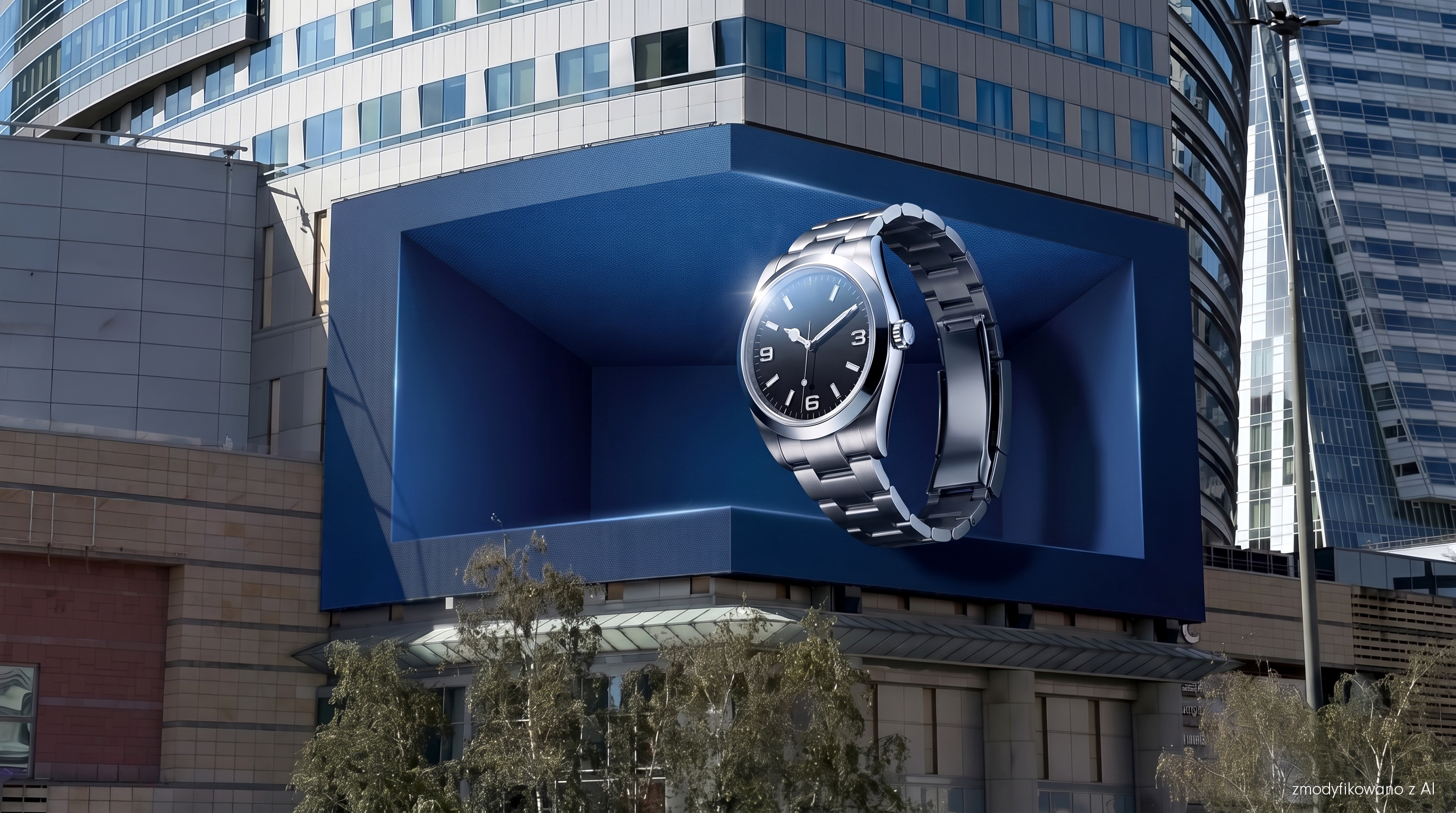
3D DOOH advertising

Want to use a DOOH screen in a way that makes it impossible to ignore? 3D DOOH advertising uses perspective, scale, and the geometry of the display to create an effect where objects appear to break out of the screen and into real space. No glasses or additional devices required for the viewer.

The screen doesn't have to end at its surface

In classic DOOH, the image stays within the screen. In 3D DOOH advertising, the perspective is designed to create an illusion of depth and space from a specific viewing point. The product can reach out of the screen, disappear into it, or move within a space that seemingly extends far beyond the LED surface.

This effect is also known as naked-eye 3D, anamorphic animation, or anamorphic 3D. It requires no special glasses. The entire illusion is created through the precise combination of screen geometry, perspective, camera angles, and 3D animation.

First the display. Then the idea.

Anamorphic advertising isn't designed like a standard animation that is simply fitted to a screen resolution at the end. The shape of the display, its proportions, corners, positioning, and the viewing angle all influence the concept from the very beginning. That is why, before starting production, we analyze the specific screen and its exposure conditions. Only then do we design the scene, camera, and movement.

The 3D effect should serve the idea

Simply "popping out of the screen" quickly loses its impact if there isn't a strong concept behind it. The most compelling projects use the illusion of space to showcase a product, its features, or a brand's personality in a way that would be impossible on a standard flat display. That is why we treat the anamorphic effect as a creative tool, not an end in itself.

What are the benefits of a well-designed 3D DOOH ad?

It utilizes space

The perspective and geometry of the display create an impression of depth, ensuring the image is no longer perceived as a standard flat advertising surface.

Showcases your product from a new perspective

3D effects allow you to leverage depth, scale, and motion to highlight your product more effectively. We can zoom in on details, adjust proportions relative to the surroundings, or make the product an integral part of the space created on screen.

Has the potential to go beyond the screen

A well-designed 3D DOOH ad can extend far beyond its original location. Its unique spatial effect encourages viewers to record and share it, giving your campaign a second life on social media.

Strengthens a modern brand image

The 3D DOOH format positions your brand as bold, modern, and savvy in its use of new communication channels. It works best when the spatial effect is consistent with your brand identity and campaign concept.

See other possibilities for movement in space.

DOOH animations

You have a few seconds, a large screen, and an audience that isn't waiting for an ad. Good DOOH animation must grab attention from the right distance, convey the message quickly, and leverage the capabilities of the specific display.

3d animation

Need to showcase a product, its details, or how it works in a realistic way? 3D animation gives you complete control over form, materials, lighting, and camera angles. It’s the perfect solution whenever your product needs to be the star of the show—from beauty shots to functional demonstrations.

FOOH animations

Discover a modern approach to advertising with FOOH (Fake Out Of Home) animations. Use innovative visual techniques to attract attention and engage your audience in a way that sets your brand apart from the competition.

advertising animation

You have only a few seconds to grab attention and convince your audience to stay. Promotional animation allows you to showcase your product quickly, build an emotional connection, and create a message that makes your brand stand out in any campaign.

No items found.

From screen geometry to spatial illusion.

We start with the specific display, its proportions, construction, and viewing angle. Based on this, we design the concept, perspective, and animation to ensure the 3D effect works perfectly from the intended vantage point.

medium and observation point

We analyze the screen, its dimensions, aspect ratio, curves, and the vantage point from which the audience will most likely view the advertisement. This is the foundation for designing the correct perspective.

Space-specific concept

We develop concepts that leverage the specific capabilities of each medium. We determine what should be placed in front of the screen, what should appear within it, and how spatial effects can enhance the product or campaign message.

3D production

We build the scene, models, materials, lighting, and animation. The camera and geometry are set to a specific viewpoint to achieve the desired naked-eye 3D effect.

rendering and preparation for broadcast

We render the final animation according to the specific screen parameters and technical requirements of the medium. We prepare the appropriate resolutions, formats, and final files ready for broadcast.

When should you use 3D DOOH advertising?

3D DOOH advertising is most effective when the product itself, its form, or the brand's character allows for a powerful spatial effect. It works exceptionally well for product launches, brand awareness campaigns, technology, automotive, entertainment, or for brands that want to use a specific location as part of their creative concept.

However, not every campaign requires an anamorphic effect. If your priority is a long message or a large amount of information, classic DOOH might be a better solution. 3D should be driven by the concept, not added just because the screen makes it possible.

The product as part of the space

One of the greatest opportunities offered by 3D DOOH is the ability to showcase a product at a scale and in a context impossible to achieve with traditional advertising. Packaging can open up within the screen, a car can seemingly drive off the surface, and a campaign character can interact with the structure of the display itself. This works particularly well when the appearance, detail, or functionality of the product is a key part of the message.

Every screen offers different possibilities

Warsaw STAGE and other screens adapted for anamorphic creative differ in their proportions, construction, and optimal viewing angles. For this reason, the same effect should not be directly transferred from one display to another. We design the concept and 3D scene specifically for each location. This ensures that the screen's geometry is not a limitation, but an integral part of the creative.

3D DOOH or FOOH advertising?

In both cases, we see things that seemingly defy the laws of reality, but the way they work is completely different. In 3D DOOH advertising, the effect is actually displayed on a physical screen and designed for its specific perspective. FOOH, on the other hand, creates the illusion of an unconventional advertisement in content primarily intended for online publication.

Learn more about FOOH advertising →

FAQ

3D DOOH advertising
#2 wyróżnia markę w natłoku reklam
Dynamiczne, kreatywne animacje przyciągają wzrok i zapadają w pamięć. Dzięki nim Twoje kampanie lepiej przebijają się przez konkurencyjne komunikaty.
#3 skraca proces decyzji i przyspiesz sprzedaż
Zamiast godzinnych prezentacji – kilkadziesiąt sekund animacji, by pokazać kluczowe korzyści. Klienci szybciej rozumieją wartość Twojej oferty, co przekłada się na sprawniejszą finalizację umów.
#4 utrzymuje uwagę widza na dłużej
Krótka i dynamiczna animacja szczególnie dobrze sprawdza się w social mediach oraz kampaniach marketingowych, zwiększając zaangażowanie i szanse na interakcję z marką.
To tylko część zalet animacji.
Chcesz dowiedzieć się więcej? Umów się na darmową konsultację – pokażemy ci jak animacja może pomóc osiągnąć cele Twojej marce.
Darmowa konsultacja

artykuły na naszym blogu

Przeczytasz w 5 min.
Przemysław Białasz

What is 3D anamorphic advertising?

Anamorphic advertising uses a specially designed perspective to create an illusion of depth on a flat screen. The viewer does not need glasses or any additional equipment, which is why the format is often referred to as naked-eye 3D. The screen can create the impression of a window leading into a much larger space. An object can appear to be deep inside a building or, conversely, cross the boundary of the screen and reach out toward the viewer. This is not a hologram or a real three-dimensional image. The entire effect is based on an optical illusion. The perspective lines, object scale, and virtual camera settings are prepared so that the image looks spatial from a specific viewing point. That is why the term "3D DOOH advertising" is significant here. It is not just about creating an animation in 3D software; it is about designing it for a specific digital display in a real-world space.

Why isn't standard 3D animation enough?

An animation might look great on a monitor, a website, or a classic advertising screen while completely failing to utilize the potential of an anamorphic display. The reason is simple: such a screen must be taken into account during the design phase. Its proportions, the number of surfaces, corners, the image-joining point, and the spot from which viewers most often look at the ad all matter. The virtual camera must correspond to this perspective. This sometimes leads to a situation where the image viewed directly in the software may look heavily distorted. Only after it is displayed on the correct screen and viewed from the right spot does everything come together into a single space. That is why a finished spot cannot simply be "converted to anamorphic." The display should be part of the creative thinking process from the very beginning.

First the screen. Then the idea.

Producing an anamorphic ad does not start with modeling a product or creating flashy movement. First, you must understand the location where the material will be viewed. We analyze the screen's construction, its proportions, and the main viewing point. The surroundings are also important: the building, the street, the direction of pedestrian traffic, or the distance from the display. All of this can influence the concept itself. A screen corner does not have to be a problem we try to hide; it can become part of the set design. Multiple surfaces can create a single digital interior. A product can utilize the scale of the facade or interact with the architecture. The 3D effect should stem from the idea, not be tacked onto it. If the only concept is "let's make something come out of the screen," it is easy to end up with a demonstration of technology rather than a good advertisement.

The space should work for the product and the brand

The most interesting anamorphic projects are not those where the most things fly toward the viewer. It is much more important why we are using the space. A product can cross the screen boundary to emphasize its form more strongly. A digital interior can reveal its construction. A change in scale can turn a small object into the main protagonist of an entire facade. There are many possibilities, but the technology should support the message. This is especially important now, as these types of projects will become more frequent. The moment an object "comes out of the screen" will eventually stop being a sufficient differentiator. A viewer might remember a flashy animation while completely forgetting which brand was behind it. Technology attracts attention. The idea determines what the viewer remembers from that attention.

What does the production of an anamorphic ad look like?

After defining the display and the creative direction, the actual 3D scene is created. Depending on the project, we prepare models, materials, lighting, the product or character's environment, and the animation itself. One of the most important elements is the camera. Its position influences whether the created space will look natural, whether the product will maintain the correct scale, and whether the individual screen surfaces will create one cohesive image. Only in such an environment do we design the movement. Finally, the animation is rendered according to the parameters of the specific display and prepared in the formats required by its operator. Resolution, frame rate, codec, or spot length can vary depending on the screen, which is why production should always be based on the current specification. This is one of the things that strongly distinguishes this format from creating a universal film that is later adapted to several aspect ratios.

3D DOOH advertising is also emerging in Poland

A great example of this format's development is the Warsaw STAGE at Złote Tarasy in Warsaw. It is a three-sided LED screen with a surface area exceeding 800 m², designed to allow for creative content that spans multiple connected surfaces. Its structure perfectly illustrates why anamorphic DOOH requires a different approach to content creation. The footage can flow between walls, utilize the building's corner, and create the illusion of a single, vast space existing behind the screen. However, Warsaw STAGE is just one example. Every screen has different geometry, proportions, and viewing conditions, which is why the same creative should not be mindlessly transferred between different displays.

3D DOOH advertising - see how we design creatives for specific screens →

Why do 3D ads have the potential to go beyond the screen itself?

An interesting feature of this format is that a campaign can operate in two spaces simultaneously. The first is, of course, the broadcast location. The large screen and unique spatial effect are designed to capture the attention of people in the immediate vicinity.

But then, the second space comes into play: the internet. People record these unique displays with their phones, post them on social media, and share them further. Campaign footage can also appear in the brand's own communications, industry media, or PR activities. You cannot engineer a viral hit or guarantee a specific number of organic shares. However, you can increase the chances that the creative will be interesting enough for viewers to want to record it. That is why it is crucial that the key moment is clearly visible in a phone recording and that the brand remains recognizable even without knowing the full context of the campaign. A well-designed DOOH campaign can thus start working far beyond the location where the screen is installed.

Anamorphic 3D advertising vs. FOOH - what is the difference?

These formats are often confused because both can feature spectacular events that seemingly take place in real space. However, the difference is fundamental. In 3D DOOH, the advertisement is actually broadcast on a physical screen. The creative must therefore be prepared for a specific display, its geometry, and the viewing angle. A passerby can actually see it on-site. FOOH, or Fake Out of Home, is primarily video content. It can show a massive product on a building, an impossible installation, or an event that never actually took place. In 3D DOOH, we design an illusion for the screen and the viewer standing in front of it. In FOOH, we design an illusion primarily for the camera and the viewer watching the finished video.

See how we create FOOH animations →

When does anamorphic advertising make sense?

Not every campaign needs a naked-eye 3D effect. If you need to convey a lot of text, a complex offer, or several pieces of information of equal importance, a classic DOOH animation might simply be a better solution. 3D DOOH is particularly interesting when the product itself allows for playing with form, material, scale, or space. It also fits well with product launches and brand campaigns where a strong first impression is key. It is also worth considering this format when the campaign has the potential to live on in social media. You have to ask yourself: "Will using the space allow us to say something more interesting about this product?" If the answer is "no," a well-designed DOOH screen animation might work better.

What do you need to know before starting production?

The most important thing, of course, is the campaign goal and the idea itself. The studio needs to know what we are communicating, who we are talking to, and what the audience should remember. Next, you need the specific media format and its current specifications. The sooner we know the screen, its parameters, and the broadcast date, the sooner we can treat its structure as an element of the creative process. For products, you may also need 3D models, technical documentation, photos, dimensions, or information about materials. Not having a ready-made model is not a problem—you just need to include its preparation in the production process. It is also worth separating two roles. The operator is responsible for the surface and the broadcast. The animation studio is responsible for the concept, design, animation, and preparation of the final content in accordance with the media requirements.

Increasingly interesting screens require increasingly better content

The development of 3D DOOH shows a larger shift taking place in outdoor advertising. A screen is less and less likely to be treated solely as another rectangular format to which we adapt a finished spot. Its scale, proportions, location, or construction can become part of the idea itself. Anamorphic 3D is one of the most spectacular examples of this approach. This does not mean that every brand should now use naked-eye 3D. It does mean, however, that the capabilities of media are developing very quickly, and the way content is designed should evolve along with them. Because a large screen in itself does not create a good advertisement. An idea that can leverage its capabilities does.

false
zacznij projekt
Poruszymy Twój brand. Dosłownie.

Dobry motion design zaczyna się od prostej rozmowy dwóch stron, które wiedzą, czego chcą. Daj znać, co planujesz, a sprawdzimy, jak zamienić statyczny przekaz w dynamikę, która przyciąga wzrok i zostaje w głowie odbiorcy.

Thank you for your message! We'll get back to you soon.
Oops! Something went wrong with the message. Try it once.

expand_less