3D Advertising in Warsaw - where can you use anamorphic animation?
Spis treści:

What exactly is 3D anamorphic advertising?
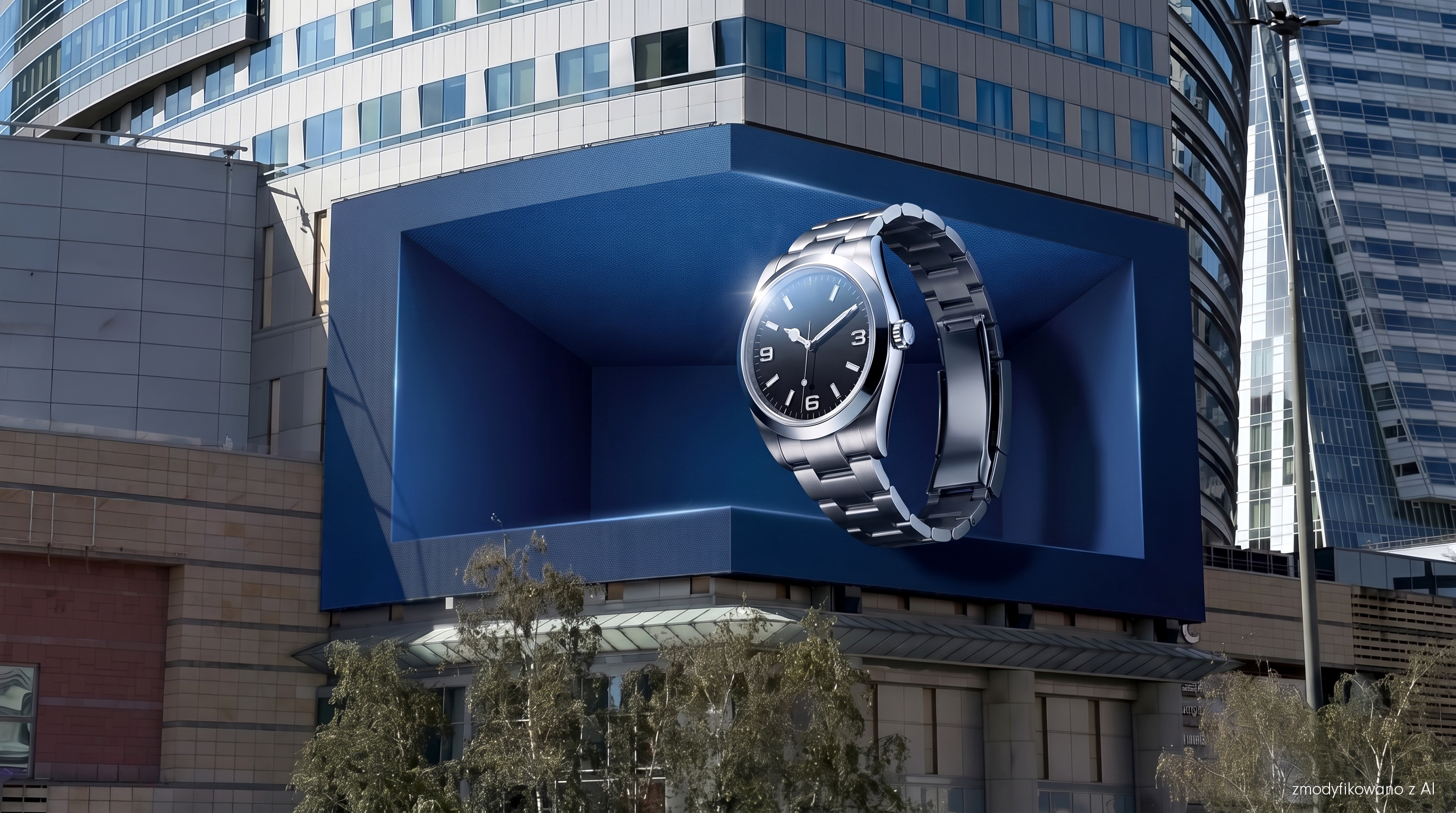
Anamorphic advertising uses perspective, screen geometry, and a precisely positioned virtual camera to create an illusion of space. When viewed from the right spot, the audience gets the impression that the screen is not a flat surface, but a window into a much deeper scene. A product can seemingly appear in front of the screen, move between its surfaces, or break the boundaries of the display. You don't need 3D glasses or extra equipment for this. The entire effect is created through a carefully prepared animation. Therefore, 3D animation alone does not automatically mean an anamorphic ad. The key is tailoring the image to a specific screen and the vantage point from which it will be viewed.
Where can you do 3D advertising in Warsaw?
Warsaw currently has several screens that offer very different possibilities for working with space. Some were designed specifically with anamorphic content in mind, while others allow for a strong depth effect thanks to their size, shape, or location.
Warsaw STAGE - three surfaces as one scene
One of the most distinctive new media formats is the Warsaw STAGE at Złote Tarasy. The screen consists of three connected surfaces and spans over 800 m². The operator states that it was designed specifically for spatial 3D creative and anamorphic animations. Its capabilities stem from more than just its size. The three surfaces allow you to treat the screen like a stage set. A product can move between walls, disappear into the background, appear to pop out in front of the screen, or use the corners as part of the animation. This is a great example of how the geometry of a medium can become the starting point for a creative concept rather than just a technical limitation.
Digital Heart of Warsaw - anamorphic screen on Marszałkowska Street
Another medium designed directly for 3D communication is the Digital Heart of Warsaw on Marszałkowska Street. The operator, screen.Art, describes it as a flagship LED surface intended for 3D anamorphic ads. The location is in the very center of Warsaw, at the intersection of Marszałkowska and Aleje Jerozolimskie. Here, too, it is not just the screen resolution that matters. The medium and the creative are treated as a single system. If you want to achieve a convincing illusion of space, the 3D scene must be built with the viewing angle and surface geometry in mind. This is what distinguishes an anamorphic ad from a standard 3D spot displayed on a large screen.
Warsaw Presidential Hotel - a massive surface in the city center
The screen at the Warsaw Presidential Hotel, formerly the Marriott, also offers great potential. The medium consists of two LED screens, each with an area of approximately 140 m². Screen Network explicitly highlights the ability to broadcast 3D spots that create the impression of three-dimensional products. This is an interesting case because the screen functions differently than a classic corner anamorphic surface. You don't always need a single, physically connected structure to leverage scale, perspective, and the illusion of depth. The most important thing is understanding the specific medium and designing the creative to fit its capabilities.
G City Promenada - 3D DOOH on the shopping center facade
Another option is located on the facade of G City Promenada. The screen installed there was designed as a 3D DOOH medium, enabling the broadcast of spatial advertising content. This shows that 3D advertising in Warsaw is no longer limited solely to the area around the Central Railway Station. Such media can also operate at shopping centers, where the campaign context is entirely different: longer contact with the space, movement, proximity to points of sale, and the opportunity to combine outdoor advertising with brand communication.
ABi Media L3D - screen by the Toruńska Route
The ABi Media L3D screen at the intersection of Modlińska and the Toruńska Route has a completely different character. It is a screen with an area of approximately 93 m² and an L-shaped design, intended for, among other things, 3D campaigns. The operator explicitly points to the possibility of broadcasting anamorphic creative content. The way it is received also changes here. In the center of Warsaw, a large part of the audience may be pedestrians. On a high-speed route, drivers and passengers are the most important. This affects the pace of the animation, the size of the product, the amount of information, and the time needed to understand the concept. Therefore, the same 3D effect should not be automatically transferred between different locations.
And what about the screen at Westfield Arkadia?
This is an interesting example because it shows that a 3D effect does not always mean classic anamorphic animation. The large screen on the facade of Westfield Arkadia has already been used for advertisements that utilize depth and elements that appear to extend beyond the surface of the medium. The screen manufacturer points to the possibility of broadcasting high-quality 3D materials. At the same time, specialists running campaigns on this screen note that as a single surface, it does not offer the same possibilities as a classic anamorphic 3D screen. However, properly utilized geometry and perspective still allow for the creation of a very convincing impression of depth. And that is precisely why it is worth distinguishing between two concepts: full anamorphic advertising and 3D creative content using a spatial effect. For the viewer, both solutions can look spectacular, but the way they are designed can be completely different.
Not every 3D screen works the same way
There is no single universal "anamorphic ad" file that can be prepared once and then sent to all screens. Each medium has different: proportions, construction, resolution, viewing angle, surroundings, and the way viewers move in relation to it. Therefore, before starting production, you need to know at least the basic specifications of the medium. In the case of more advanced projects, we use this as a basis to build a 3D representation of the space and set up a virtual camera that corresponds to the viewer's perspective. Only then can we check how the designed product will behave in the final space.
First the screen. Then the idea.
In a classic campaign, you can come up with a spot first and only then choose where to air it. With anamorphic advertising, such a process can limit the effect. If we know that the screen has a corner, multiple surfaces, or characteristic geometry, we can use these elements while creating the concept. The product doesn't just have to appear in a virtual box. It can become part of the architecture. It can pass through the building's surface. It can change scale. The product material can react to the environment. The brand identity element can build the entire space. So, a good question at the beginning of a project is not: "What can we do in 3D?" It is better to ask: "What do the capabilities of this screen allow us to say about the product or brand?" Technology grabs attention. The idea determines what the viewer remembers from that attention.
What does the production of an anamorphic advertisement look like?
The first step should be defining the campaign goal and selecting the medium. The studio needs its technical specifications and information to properly prepare the scene. Next, a concept is developed. At this stage, it is worth thinking not only about a striking visual but also about the product, the brand, and a single message that the viewer should remember. Once the direction is set, the actual 3D production begins: modeling, materials, lighting, animation, and spatial construction. One of the most important elements is the camera. It is the precise combination of the scene and the observation point that creates the illusion, making a flat surface appear to have depth. Finally, the final render is prepared along with files that meet the parameters required by the operator of the specific screen.
What works best in 3D DOOH advertising?
The most spectacular effect is not always the best solution. You can create a giant character jumping out of the screen, but if the viewer doesn't remember the product or brand after a few seconds, the technology is working for its own sake. In 3D advertising, you can make excellent use of a product's properties: its scale, shape, material, functionality, transformation, or a distinctive brand identity element. This way, the spatial effect is not just an add-on to the ad; it becomes a way to tell its core story.
3D advertising in Warsaw can reach further.
The physical broadcast takes place in a specific location, but the campaign's reach doesn't have to end there. Anamorphic ads have one important quality: they look good when recorded. The unusual spatial illusion can encourage passersby to pull out their phones, and the footage from the broadcast can later be used on social media, in PR communications, on LinkedIn, or in the brand's own materials. This doesn't mean every 3D ad will automatically go viral. However, it is worth designing with two audiences in mind: the one who sees it live and the one who later sees the recording on their phone. This can even influence the composition of the scene. An element that looks good from a distance should still be legible when framed within a vertical smartphone screen.
3D DOOH or FOOH advertising?
These two formats are often confused because the final recordings can look similar. However, the difference is fundamental. In 3D DOOH the advertisement actually appears on a physical screen. Therefore, production must take into account the specific medium, its geometry, and its location. In FOOH the final product is a video clip. A physical installation does not need to exist, so the product can appear in virtually any place and at any scale. In the case of 3D DOOH advertising, the viewer can stand in front of the screen and see the effect live. FOOH, on the other hand, offers much greater freedom in altering reality. It is not a question of which format is better; they are simply two different tools.
When is it worth using 3D advertising in Warsaw?
Not every campaign needs an anamorphic screen. This format makes the most sense when the product or brand itself allows for a compelling spatial effect. This could be a product launch, a brand campaign, a new service rollout, or an initiative where content intended for later online distribution is a key element. It works much less effectively when you try to cram too much information, multiple promotional messages, a large number of products, or extensive text onto the screen. A large screen doesn't mean the viewer has more time. In urban spaces, they often have even less. That is why anamorphic advertising usually works best when it can be distilled into a single, clear idea.
The animation studio and the screen operator are responsible for different parts of the campaign
When planning your first 3D DOOH campaign, it is worth separating two things: media buying and content production. The screen operator is responsible for screen availability, scheduling, media space purchasing, and technical broadcast requirements. The animation studio is responsible for the concept, 3D scene preparation, animation, and final assets tailored to the screen's specifications. You don't need to come to the studio with a screen already selected and a full set of documentation. You can start with your campaign goals and ideas, and choose the specific media space at a later stage. The only important thing is not to delay this decision until the animation is already finished.
Warsaw now offers real opportunities for 3D advertising
Warsaw STAGE, Digital Heart of Warsaw, Presidential, Promenada, L3D by the Toruńska Route, and the screen at Westfield Arkadia show that 3D advertising in Warsaw is no longer just a technological novelty. Brands have a variety of screens to choose from, each with a different character. From massive surfaces in the city center to screens at shopping malls and locations targeting heavy vehicular traffic. This offers much more potential than just "creating a 3D effect." You can match the screen to your audience, campaign goals, and product, and then design the motion specifically for that space. Because in good anamorphic advertising, the screen isn't just a place to display a finished animation—it is part of the idea itself.